Negroni Talks #S22 - Thursday 29th October 2026 @ EH Smith, Digbeth, Birmingham
Making Brumm-a-gem: Luxury Lifestyle or Local Livelihoods?
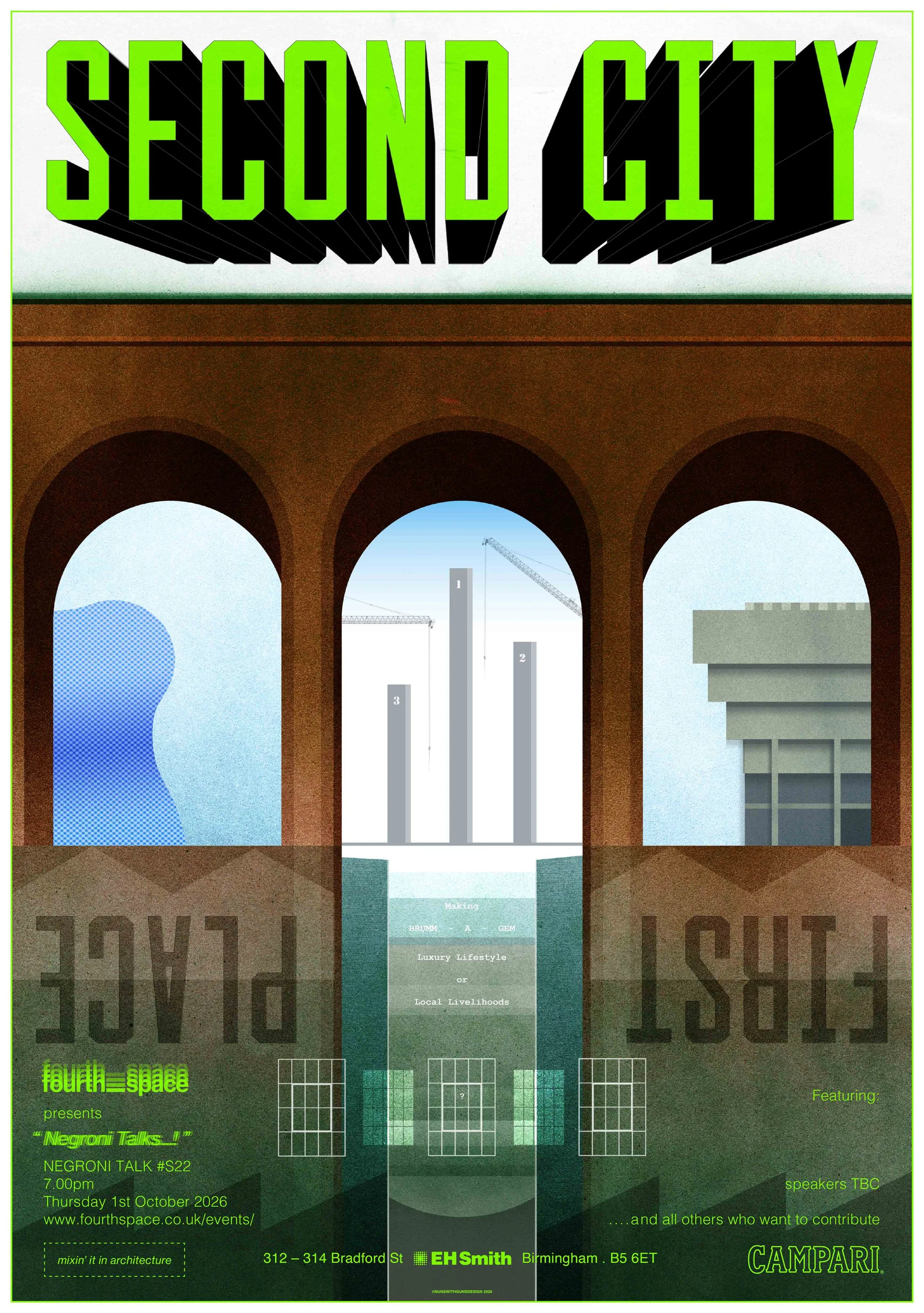
Birmingham is often termed Britain’s "second city" despite historical claims from Liverpool, Glasgow and Bristol, and the more recent challenge from Manchester. Like many second cities around the world, this can create a complex, self-conscious relationship with the capital – a mix of rivalry, inferiority complex and a constant need to cultivate a distinct identity. On what basis then is a second city significant beyond merely having the second largest population?
Birmingham is multi-cultural, young and centrally located, and yet it still seems to be searching for rejuvenation and resolution through a unifying vision. This tension can be seen in the historical treatment of its architectural heritage – from Victorian to Brutalism – where recurring episodes of demolition suggest a city that has struggled to reconcile with its own identity. Emerging from its recent financial crisis, is the city of 2026 unsure of itself, or striding forward with confidence about what it needs to be? These are questions faced by towns and cities across the country, but ones that seem ever more urgent in these poorer, populist times.
Politically, the pressure of ‘being seen to be doing things’ means there is always the danger of being seduced by the boosterism of statement buildings and shiny new skyscrapers, whilst neglecting the small things that make up a place’s civic virtue. Of being more concerned with appearing ‘attractive’ to outsiders than attractive for those already living there. Whilst there’s always a need to balance the books and get the money in, the initial sugar rush of investment and regeneration cannot mask structural inequality and poverty.
As an industrial area adjacent to the city centre, the significant regeneration of Digbeth, often referred to as Birmingham’s "Creative Quarter", is a litmus test for how the city defines itself. With the imminent arrival of HS2 right next door, what else will be brought with it? The heritage-led masterplan will raise familiar concerns around gentrification and displacement, loss of cultural identity, rising costs, lack of affordable housing, poor housing variety and lack of local engagement. There is a fear that the very "grit" and "weirdness" that made Digbeth a haven for low-cost opportunities in its workshops, venues and clubs will be erased by investor-friendly, high-end developments.
There is a huge opportunity to put under-utilised areas of Digbeth to better use and improve a significant part of the cityscape. Yet whilst conservation, retrofit and adaptive reuse are all noble pursuits, they are predominantly concerned with material retention rather than any social and economic implications. Does Birmingham seek to simply emulate urban trends elsewhere, with refurbished arches, warehouses and canalside offering an alternative version of the post-industrial city, in which ‘rawness’, ‘edge’ and ‘authenticity’ are marketed as high-value consumer spaces that command an increasingly higher price?
Known as the city of 1000 trades, through the industrial revolution Birmingham was not built on a single large-scale industry like cotton or steel, but on thousands of smaller firms, creating the economic resilience, entrepreneurship and innovation that made it the Workshop of the World. However, long before this it was a legislative market charter in 1166 that significantly freed the city from feudal control and provided the real opportunities for growth. What then are the current day policies and initiatives that will bring greater prosperity to the population throughout all areas of the city?
Can these characteristics of scale and variety be translated into an urban renaissance, with density and diversity helping to deliver a more equitable, well-designed landscape?
Or will the city simply serve itself up ‘under-developed areas’ to the oligopoly of real estate, construction and design?
Many second cities are rebranding themselves as centres of innovation, culture and "liveability", striving for an authentic, modern identity. What can Birmingham learn from Marseille, Milan, Montreal, Barcelona or Melbourne – none feels ‘second-best’. So how does Birmingham join them by being bold, better, different and a destination?
What can it learn from the recent Manhattan-isation of Manchester?
Will Birmingham be seen as an alternative city, representing an alternative architecture?
Will it be more about local livelihoods, or more of the same ‘luxury living’?
True innovation is about speculative thinking, being progressive, doing things differently while remaining practical, meeting needs and solving problems. If Birmingham’s past success was built out of the conditions of its time, then what new forms of success might emerge from the economically challenging realities of the 21st century?
Speakers: TBC
Tickets: TBC